Every app in the segment advertises more classes, more features and a slightly lower price. Each launch copies the last, margins fall and the customer chooses by this month’s discount.
When an industry competes on the same factors, improving each of them tends to produce an endless race. Blue Ocean Strategy proposes another question: what if the company stopped competing on some of those factors and started offering something the industry ignores?
What Blue Ocean Strategy is
The strategy was presented by W. Chan Kim and Renée Mauborgne in the book Blue Ocean Strategy, based on a study of 150 strategic moves over more than a hundred years, across thirty industries (Wikipedia).
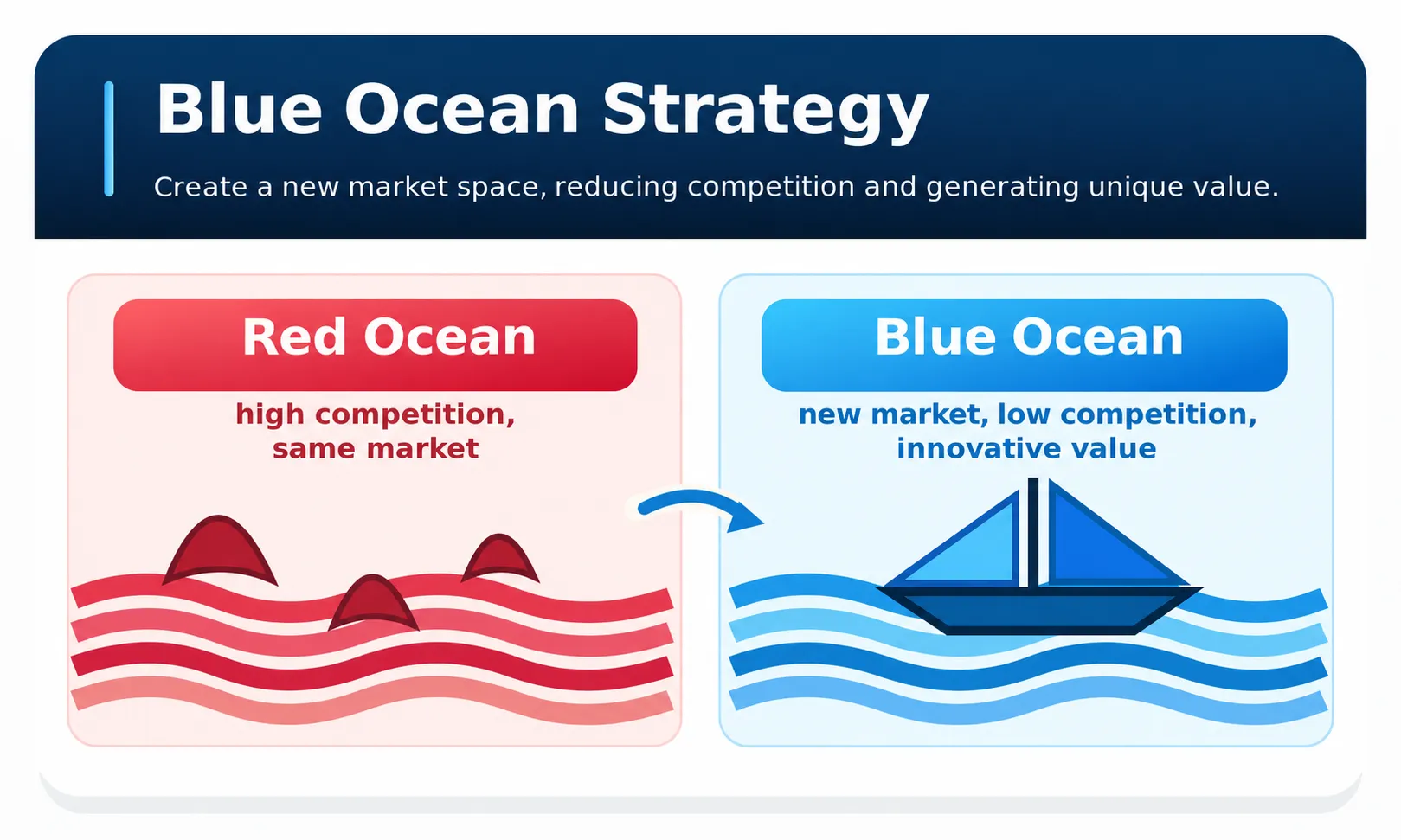
The authors call the known market, where companies fight over the same demand, the red ocean, and the still little-explored space the blue ocean. The idea linking the two is value innovation: breaking the usual trade-off between value and cost by pursuing differentiation and low cost at the same time. This often comes from no longer doing expensive things the customer barely values.
The two tools
The value curve is a picture of how offerings position themselves on the industry’s competitive factors. When every company’s curve looks alike, competition is over small differences.
The ERRC grid is the tool for changing that curve (Blue Ocean Strategy). It comes from four questions:
| Action | Question |
|---|---|
| Eliminate | Which factors the industry takes for granted can disappear? |
| Reduce | Which factors can go well below the industry standard? |
| Raise | Which factors should go well above the industry standard? |
| Create | Which factors has the industry never offered that should exist? |
Eliminating and reducing lower costs. Raising and creating increase value. The combination of the four actions is what produces value innovation.
When to use it and when to avoid it
When to use it
- Saturated markets with falling margins
- Repositioning a product
- Business model innovation
- When the industry's offerings have become too alike
When to avoid it
- When the product doesn't yet solve the basic problem well
- When regulatory requirements don't allow cutting factors
- In markets still growing, with room for everyone
- As a justification for skipping competitive analysis
How to apply it
- List the competitive factors. Ask what the industry invests in and what customers compare.
- Draw the value curve. Compare your offering with the main alternatives on each factor.
- Look at those who don’t buy. Understand why these people give up, refuse or use another solution.
- Apply the ERRC grid. Decide what to eliminate, reduce, raise and create, with a justification for each item.
- Write the proposition and the hypotheses. State what must be true about demand, cost and differentiation, and test it.
Example: a fitness startup changes the curve
A fitness startup competes with apps offering ever more classes. Interviews with people who abandoned those apps suggest the problem isn’t a lack of content, but not knowing what to do on a given day. The team compares the current curve with an alternative:
| Factor | Industry | Proposition | Action |
|---|---|---|---|
| Lock-in contract | Common | None | Eliminate |
| Number of classes | High | Medium | Reduce |
| Rarely used features | Many | Few | Reduce |
| Contextual coaching | Low | High | Raise |
| Integration with health routines | Rare | Central | Create |
The proposition is to stop selling access to a catalog and start selling affordable coaching. It depends on hypotheses, which are the real output of the exercise:
- Demand: will people who gave up on other apps pay for coaching? Test with a waiting list and a paid pilot.
- Cost: does AI coaching fit the target price? Measure the cost per active user in the pilot.
- Retention: without lock-in, does cancellation undermine the business? Compare cohorts.
- Regulation: integrating health data involves sensitive personal data. Assess the legal requirements before building.
How to read this strategy with skepticism
The idea has great appeal, which is why it deserves care:
- A space without competitors may be a space without customers. An empty market may be empty for a good reason.
- Success stories are told afterwards. Critics point out that this kind of analysis tends to look at who succeeded and leave out those who tried the same and failed (Satell, 2022).
- The advantage isn’t permanent. Any differentiated proposition can attract imitators, and new factors become standard over time.
- Cutting carries risk too. A factor customers rarely mention may be essential to the purchase.
So the promise of “eliminating the competition” should be read with care. The realistic goal is to change the terms of competition for a while, at a cost that makes sense.
How to use an LLM
An LLM helps list competitive factors, suggest what could be eliminated and write hypotheses. It tends to repeat the industry’s conventional wisdom, and it may describe competitors incorrectly. Bring evidence from customers and non-customers, and check any claim about real companies.
Apply the principles of Blue Ocean Strategy to the [market] segmentfor the audience [profile].Known competitors and competitive factors: [list].Unmet needs: [evidence].Who doesn't buy and why: [evidence].Resources and limitations: [describe].
Map the main attributes the offerings compete on.Propose an ERRC grid: what to eliminate, reduce, raise and create,justifying each item.
Write two alternative value propositions, with hypotheses about demand,cost and differentiation, and validation experiments for each.Avoid claiming competition has been eliminated without evidence. Don'tinvent data about real competitors.
Expected output: a map of factors, an ERRC grid and hypotheses of new value.
Before trusting the answer:
- Test against real customers. Factors and needs must come from research, not just the model.
- Look for who already tried. Ask which companies tried something similar and why they failed, and check the sources.
- Do the cost math. Verify that what was eliminated really pays for what was created.
- Sanitize the context. Don’t share customer data or confidential plans.
Combine it with other frameworks
- Porter’s Five Forces: shows the industry’s structural pressure, which is the reason to look for another space.
- Lateral thinking: helps generate ideas for the “create” column.
- Hypothesis testing: validates demand before investing in the new proposition.
- Cost-benefit analysis: checks whether the new curve pays for itself.