A trucking company has already optimized its routes, trained its drivers and looked after tire pressure. Each new percentage point of fuel savings costs more than the last. The team goes back to the same spreadsheets, hunting for another 1%.
When improvement within the pattern runs out, digging deeper in the same hole yields little. Lateral thinking proposes digging somewhere else: changing how you look at the problem before searching for the solution.
What lateral thinking is
The term Lateral Thinking was introduced by Edward de Bono in 1967. It describes a deliberate way of leaving dominant patterns of reasoning and reaching ideas that step-by-step progress wouldn’t (Wikipedia).
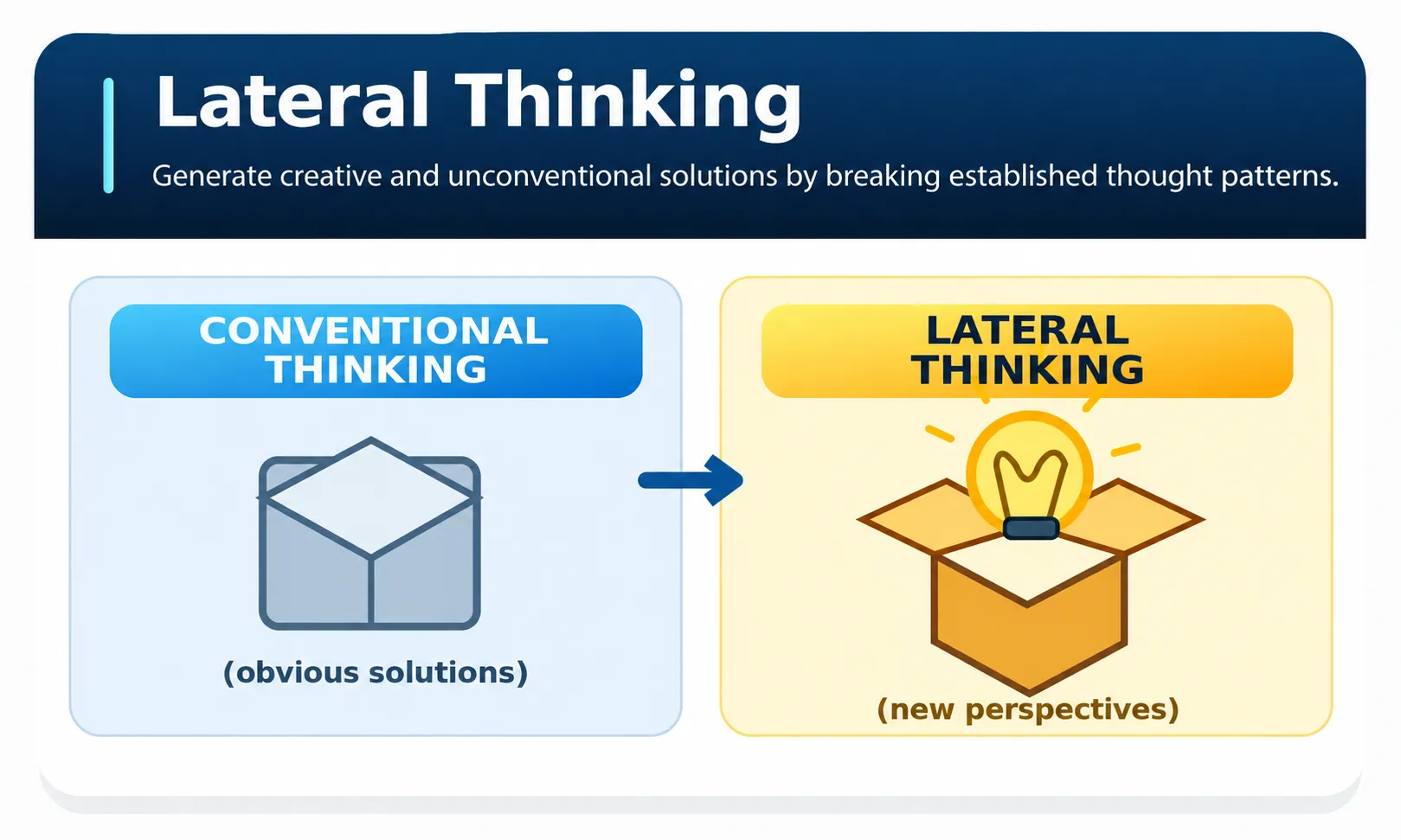
De Bono contrasts it with vertical thinking, which advances logically and in sequence. The difference also shows in how an idea is treated. Critical thinking asks whether it’s true. Lateral thinking asks where it leads, which de Bono calls its movement value. A wrong idea can be very useful if it leads to a good one.
Four techniques
- Inversion. Flips the premise and asks: what if we wanted the opposite?
- Provocation. States something false on purpose and asks: where does this lead?
- Analogy. Imports solutions from another field and asks: who solved something similar?
- Recombination. Joins separate parts and asks: what can go together?
How provocation works
Provocation is de Bono’s most characteristic technique, and the most misunderstood. It’s a statement known to be wrong or impossible, used on purpose. He suggested the word po to mark it, signaling that it isn’t a proposal.
A classic example is “the factory is downstream of itself”. As a claim, it’s absurd. But it leads to a real idea: requiring a factory to take in water after the point where it discharges its waste, so it’s the first to feel its own pollution.
The next step is movement: instead of judging the sentence, the team extracts a principle, looks at what changes or imagines what would happen if it were true. Without movement, a provocation is just a joke in a meeting.
When to use it and when to avoid it
When to use it
- Problems where the known ways out have run dry
- Rigid constraints that call for another approach
- Cutting costs beyond ordinary optimization
- New services and better user experience
When to avoid it
- Technical problems with a known solution
- Emergencies, where following the procedure is safer
- When there's no time or willingness to test anything
- As a substitute for analyzing the cause of a problem
How to apply it
- Define the goal and the limits. Write the measurable target and what can’t be violated, such as safety and laws.
- List what’s been tried. This avoids spending the session on the usual ideas.
- Surface the premises. Ask what everyone assumes without discussion.
- Generate without judging. Use the four techniques, with a set time. Criticism comes later.
- Make the movement. Turn each provocation into something you can describe as an idea.
- Assess separately. Run the ideas past the limits and pick a few, by impact, viability and risk.
- Design a cheap test. Each chosen idea needs a small experiment.
Example: burning less fuel
A trucking company with 40 trucks wants to cut fuel use by 12% in a year without adding delays. It has already tried optimizing routes, training drivers and preventive maintenance. The limits are clear: no cutting rest breaks, raising speed or exceeding weight.
Inversion: “what if we wanted to burn as much as possible?” The answer is revealing: leave trucks idling, come back empty, deliver at rush hour. Flipping it back brings two ideas:
- Schedule dock slots, to cut waiting with the engine running.
- Look for return loads on trips that come back empty.
Provocation: “po: the customer comes to pick up the load.” Absurd for someone buying a fridge, but the movement suggests shortening the last stop:
- Create pickup points in neighborhoods with many deliveries.
- Offer a discount to those who accept a consolidated weekly delivery.
Analogy: airlines sell the same seat at different prices. Demand can be shaped:
- Charge less for off-peak delivery windows.
Analogy: carpooling splits a trip.
- Share loads with a carrier that isn’t a direct competitor.
Recombination: joining transport modes and incentives.
- Use rail for the long haul and trucks only at the ends.
- Offer driver benefits from telemetry that also rewards safety.
Only now does the assessment begin. Idea 8 is put off: a badly designed bonus can encourage rushing, which breaks a limit. The others pass the filter, and the team picks three:
| Idea | Impact | Cheap test |
|---|---|---|
| Dock slots | Medium | Two customers for four weeks |
| Return loads | High | One route for two months |
| Window pricing | Medium | Offer to twenty customers |
Note that none of the three touches routes or drivers. They go after waiting, empty trips and the timing of demand, which didn’t even come up in the initial discussion.
What the evidence shows
The concept is influential, but its base is weaker than its fame. Critics point out that de Bono’s central ideas have never been rigorously tested, and an assessment of 42 thinking frameworks found little evidence that his training improves thinking in general (Moseley et al., 2005).
That doesn’t mean creativity can’t be trained. A review of 70 studies concluded that well-designed programs typically produce gains, especially those focused on cognitive skills and heuristics (Scott, Leritz & Mumford, 2004). But that result holds for programs as a whole, not for de Bono’s techniques in particular, and later reviews point to signs of publication bias.
The prudent position is to use these techniques as facilitation tools, without treating them as proven, and to judge the result by the experiments they generate.
How to use an LLM
An LLM is good at volume: it generates dozens of variations in seconds, and it neither tires nor gets embarrassed by strange ideas. On the other hand, it leans toward the most common answers, and its provocations tend to be timid. Even with constraints stated, it may suggest unsafe shortcuts, so the assessment remains the job of those who know the operation.
Act as a lateral thinking facilitator for [problem].Measurable goal: [result].Safety, budget and legal constraints: [describe].Conventional solutions already tried: [list].
Generate ideas through four approaches: inverting the premise,provocation, analogies with other fields and recombination.Present at least eight distinct ideas, without judging them at first.Don't suggest shortcuts that violate safety or regulation.
Then select three to assess for viability, impact and risks, proposinga cheap experiment for each.
Expected output: a portfolio of ideas and initial experiments.
Before trusting the answer:
- Cut the obvious. If the idea was already on the list of things tried, ask for another.
- Ask for stronger provocations. Require statements that are truly impossible, and the movement from each.
- Apply the human filter. Those who run the process assess safety, legislation and cost.
- Sanitize the context. Costs, contracts and customer data shouldn’t go into public tools.
Combine it with other frameworks
- First-principles thinking: rebuilds from fundamental premises; lateral thinking generates alternatives through deliberate association.
- Six Thinking Hats: the green hat is the time to use these techniques.
- Blue Ocean Strategy: helps fill in the “create” column of the ERRC grid.
- Decision matrix: compares ideas in the assessment stage.
- Hypothesis testing: turns the chosen idea into an experiment.
References
- de Bono, E. (1967). The Use of Lateral Thinking.
- de Bono, E. (1970). Lateral Thinking: Creativity Step by Step. Harper & Row.
- Moseley, D., Baumfield, V., Elliott, J., Gregson, M., Higgins, S., Miller, J. & Newton, D. (2005). Frameworks for Thinking: A Handbook for Teaching and Learning. Cambridge University Press.
- Scott, G., Leritz, L. E. & Mumford, M. D. (2004). The effectiveness of creativity training: A quantitative review. Creativity Research Journal, 16(4), 361–388. DOI
- Wikipedia. Lateral thinking. Link