A company wants to decide whether to enter a new market. In one afternoon, the team fills four quadrants with dozens of sticky notes, the grid goes into the slide deck and, a month later, nobody looks at it again.
The literature has a record of this script. Reviewing how consultants used SWOT in a UK government program, Hill & Westbrook (1997) found long lists averaging more than 40 factors, generic descriptions, no prioritization and no verification of the items. The most uncomfortable finding was another one: nobody used those outputs in the later stages of strategy.
The problem rarely lies in the four quadrants. It lies in stopping there. This article shows how to use SWOT to support a concrete decision: how to classify each factor, how to prioritize, how to cross the quadrants and how to ask an LLM for help without letting it invent the diagnosis.
What SWOT analysis is
The acronym stands for Strengths, Weaknesses, Opportunities, Threats. The method assesses an organization, a product or a project along two dimensions: where a factor comes from and whether it helps or hurts the objective.
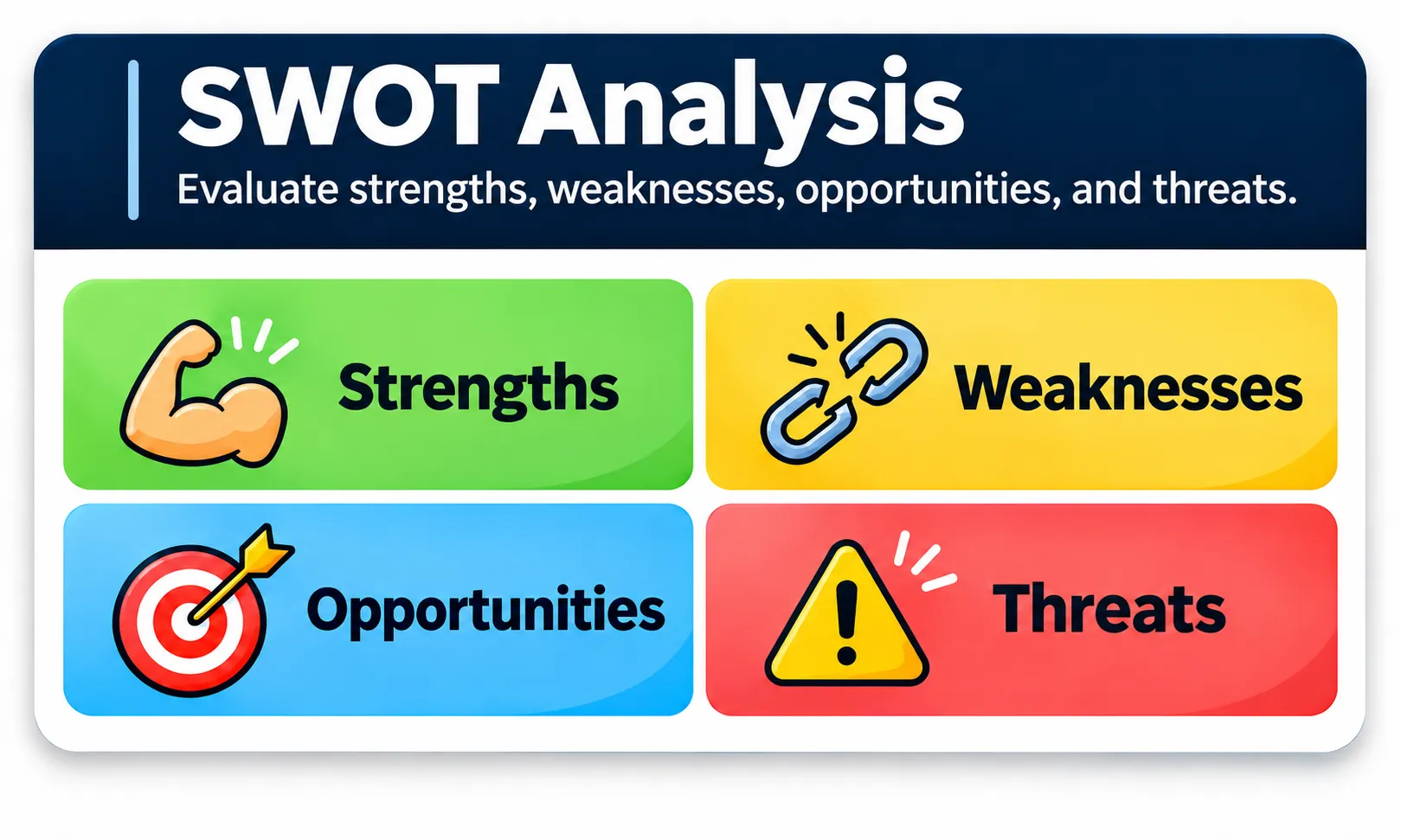
| Helps the objective | Hurts the objective | |
|---|---|---|
| Internal (the organization controls it) | Strengths | Weaknesses |
| External (the organization doesn’t control it) | Opportunities | Threats |
The most useful test is the control test: can the organization change this factor directly? If so, it’s internal. If not, it’s external. The test prevents the method’s most common mistake, which is writing “launch an app” under opportunities. That’s a possible action. The opportunity is the external condition that justifies it, such as demand growing in a segment.
The same factor can also change quadrants depending on the decision. A small team is a strength when the goal is speed and a weakness when the goal is covering a large market. That’s why the analysis only makes sense in relation to an objective.
Where it came from
SWOT’s origin stayed unclear for decades. Drawing on archives and interviews, Puyt, Lie & Wilderom (2023) name Robert Franklin Stewart as its originator. The method began as SOFT: managers classified planning issues, with evidence, as safeguarding the satisfactory, opening opportunities, fixing faults and thwarting threats. An earlier version of the work places the empirical roots at Lockheed in 1952, and records Stewart’s report on the SOFT approach in 1965 and the move to the SWOT label in 1967 (Puyt et al., 2020).
The detail matters because, at its origin, the classification fed the work of an executive planning committee. It was one stage of a process, not a standalone slide.
When to use it and when to avoid it
When to use it
- Before a strategic decision with a defined scope and deadline
- Market entry, product repositioning or investment
- To align a team around a shared reading of the situation
- As a first step, before more specific analyses
When to avoid it
- When there is only a generic request for a diagnosis, with no decision to make
- To prove the cause of a problem: Ishikawa and 5 Whys work better
- To compare options already defined: use a decision matrix
- To understand an industry's structure: use Porter's Five Forces
How to apply it
- Define the decision. Write down the question, the horizon and the success criterion. “Do we enter healthcare within 12 months?” works better than “analyze the company”.
- Gather evidence before giving opinions. Use product metrics, churn, customer interviews, market reports and regulation. Record the source of each item.
- Classify with the control test. Each factor goes into a single quadrant, always in relation to the chosen decision.
- Prioritize. Keep up to five items per quadrant, ranked by impact on the decision and confidence in the evidence. This is where most SWOTs fail.
- Cross the quadrants and define actions. Each action needs an owner, a metric and a next step.
From the grid to action: the TOWS cross
Weihrich (1982) proposed the TOWS matrix precisely to link external factors to internal ones and derive strategies from them. The logic is simple: each action comes from a pair.
| Cross | Question | Type of move |
|---|---|---|
| Strength × opportunity | How do we use our best assets to capture this opportunity? | Advance |
| Strength × threat | How do we use our strengths to reduce this threat? | Defend |
| Weakness × opportunity | What must change so we don’t miss this opportunity? | Fix |
| Weakness × threat | Where are we most exposed, and how do we limit the damage? | Reduce exposure |
Without an owner and a metric, the cross just becomes a second list.
Example: an AI startup assesses a new market
An AI startup with retail customers is assessing entry into healthcare within 12 months. The decision is whether it’s worth opening this market now, with the current team.
| Quadrant | Item | Evidence | Confidence |
|---|---|---|---|
| Strength | MLOps experience | Models in production with in-house monitoring | High |
| Weakness | Limited sales team | No salesperson with experience in the sector | High |
| Opportunity | Growing demand | Requests for proposals received without active prospecting | Medium |
| Threat | Regulatory requirements | Requirements still under legal review | Medium |
| Threat | Established competitors | Long contracts reported in interviews | Low |
The lowest-confidence item is a threat capable of changing the decision, which shows where to research first. The cross yields four actions:
- Strength × opportunity: offer a pilot to one of the interested parties, backed by the MLOps experience. The metric is a signed pilot within the quarter.
- Strength × threat: use monitoring and the audit trail as an answer to regulatory requirements, after the legal review.
- Weakness × opportunity: look for a sales partner active in the sector before hiring an in-house team.
- Weakness × threat: don’t take on contracts that depend on requirements not yet mapped.
How to use an LLM
An LLM is good at organizing loose notes, spotting items in the wrong quadrant, suggesting questions and proposing crosses. It doesn’t know your operation, and market data it cites from memory may be outdated or invented. Treat the answer as a draft from an analyst who has just joined the company.
Act as a strategy analyst. I need to assess [company/project/product]to decide [specific decision] within [timeframe].
Context and available data: [describe].Target audience and market: [describe].Constraints: [budget, team, compliance, deadline].
Build a SWOT analysis, correctly separating:- Strengths and weaknesses: internal factors the organization controls;- Opportunities and threats: external factors it doesn't control.
For each item, give the available evidence, the impact (high/medium/low)and the confidence level. Limit each quadrant to five items and point outdata gaps. Then propose up to five actions by crossing the quadrants(strength × opportunity, strength × threat, weakness × opportunity,weakness × threat), with a suggested owner, metric and next step.
Don't confuse hypothesis with fact. Don't invent data. If informationis missing, say what is missing.
Expected output: a 2 × 2 matrix with evidence, a list of hypotheses to verify and a short action plan.
Before trusting the answer:
- Check the sources. An item without evidence goes back on the list as a hypothesis.
- Cut the generic. If an item would fit any company in the sector, it doesn’t help with this decision.
- Ask for the counterpoint. Ask what would have to be true for the recommendation to be wrong.
- Sanitize the context. Don’t paste personal data, trade secrets or contracts into public tools.
Combine it with other frameworks
- Porter’s Five Forces: SWOT diagnoses an organization’s position, while Porter analyzes the competitive structure of the industry. Porter’s output feeds opportunities and threats.
- Scenario planning: tests whether the actions hold up under different futures.
- Decision matrix: compares the actions that came out of the cross, with explicit criteria and weights.
- Hypothesis testing: turns low-confidence items into experiments.
References
- Hill, T. & Westbrook, R. (1997). SWOT analysis: It’s time for a product recall. Long Range Planning, 30(1), 46–52. DOI
- Puyt, R. W., Lie, F. B. & Wilderom, C. P. M. (2023). The origins of SWOT analysis. Long Range Planning, 56(3), 102304. DOI
- Puyt, R. W., Lie, F. B., de Graaf, F. J. & Wilderom, C. P. M. (2020). Origins of SWOT analysis. Academy of Management Proceedings. DOI
- Weihrich, H. (1982). The TOWS matrix: A tool for situational analysis. Long Range Planning, 15(2), 54–66. DOI