The meeting is about moving from selling licenses to subscriptions. Finance shows a spreadsheet. Someone says customers will hate it. Someone else proposes a hybrid plan and promptly hears that “that never worked”. Forty minutes later, everyone has talked about something different, and the same arguments are back for the third time.
The problem isn’t a lack of ideas. Facts, fears, risks and proposals are competing for the same space. The Six Hats separate those modes of thinking, so the team does one thing at a time.
What the Six Thinking Hats are
The method was presented by Edward de Bono in the book Six Thinking Hats, from 1985. Each hat stands for a mode of attention, and putting it on, even figuratively, signals how the group will think at that moment.
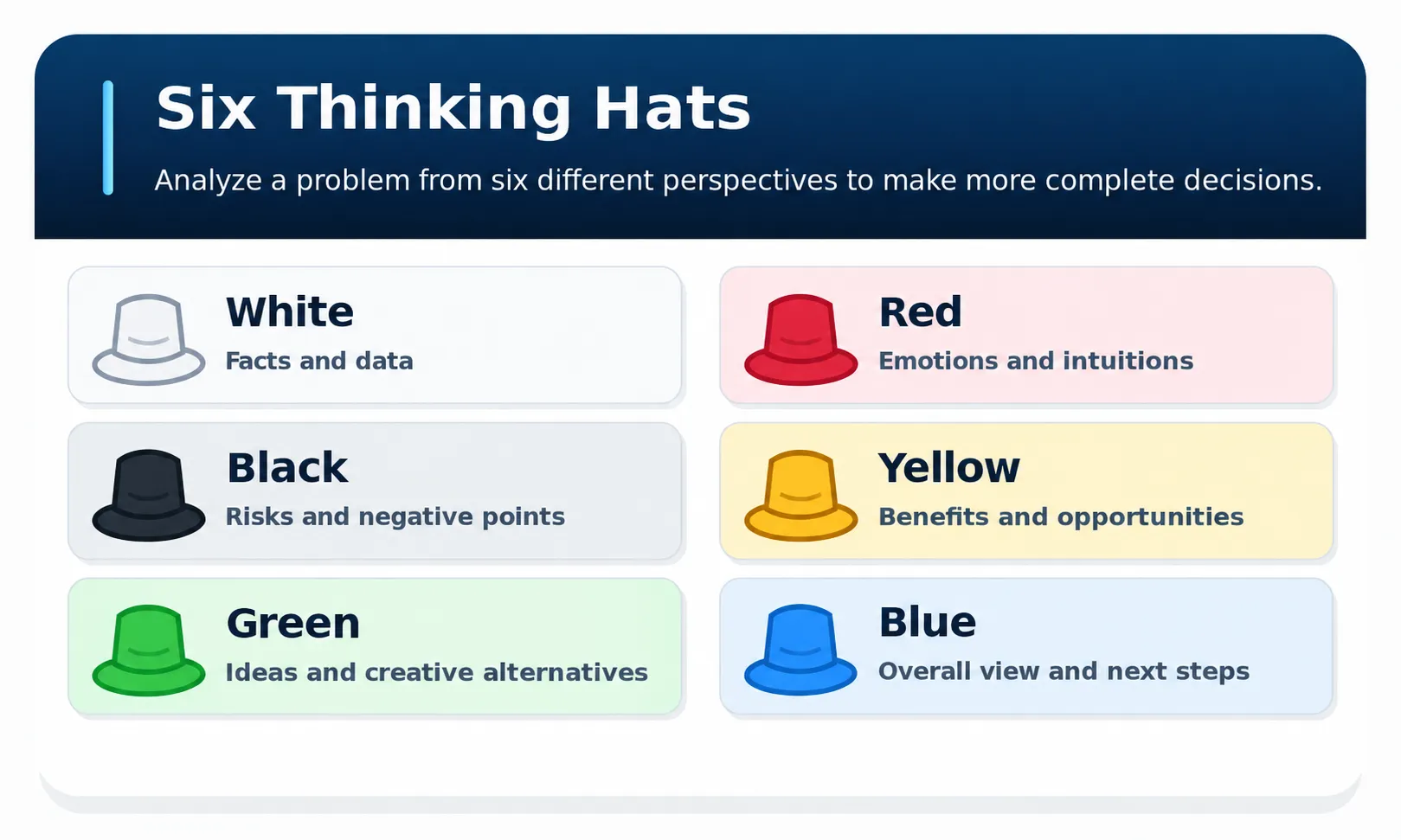
| Hat | Focus | Question |
|---|---|---|
| White | Facts and gaps | What do we know, and what’s missing? |
| Red | Intuition | How do we feel about this? |
| Black | Caution | What could go wrong? |
| Yellow | Value | Why could this work? |
| Green | Alternatives | What other options exist? |
| Blue | Process | What do we do now? |
This article is about human facilitation of the technique. For use with LLMs, multi-agent systems and harnesses, read Six Thinking Hats in the Age of LLMs.
The rules that make the method work
- Same hat, same time. This is parallel thinking. Instead of one person attacking while another defends, everyone looks in the same direction (deBono). Under the black hat, even those who back the idea look for risks.
- A hat isn’t an identity. Treating them as personality types distorts the method. Nobody is “the team’s black hat”.
- Red without justification, black with it. Feelings come in without needing an explanation. Criticism needs reasons.
- Red is short. About 30 seconds, to capture the reaction before it turns into an argument (Wikipedia).
The blue hat
Blue is the “thinking about thinking” hat. It sets the agenda, sequence and focus, keeps the rules and asks for summaries and decisions. So it isn’t one more voice in the conversation. It usually falls to whoever facilitates, and it opens and closes the session.
There’s no single order
The sequence changes with the goal. Some suggestions:
| Goal | Sequence |
|---|---|
| Initial ideas | Blue, white, green, blue |
| Quick feedback | Blue, black, green, blue |
| Solving a problem | Blue, white, green, red, yellow, black, green, blue |
It’s worth putting yellow before black when the team tends to kill ideas early, and having a green after black to respond to the risks raised.
When to use it and when to avoid it
When to use it
- Meetings where people repeat themselves or attack each other
- Decisions involving several areas
- Architecture debates and product innovation
- Controversial solutions, with positions already formed
When to avoid it
- Simple decisions that would fit in a message
- When the basic data for discussion is missing
- Conflicts of power or interest, which the technique doesn't solve
- When the decision is made and the session is just theater
How to run it
- Open with blue. Define the question, the expected result and the sequence of hats.
- Bring the facts in advance. Ask for the data beforehand, so white doesn’t turn into live research.
- Keep time. A few minutes per hat is usually enough. Red is far shorter.
- Keep everyone under the hat. When a risk comes up during yellow, note it and say it will come back in black.
- Record by hat. One column for each stops everything turning into a single list.
- Close with blue. Sum up options, disagreements, missing data, the decision and owners.
Example: moving from licenses to subscriptions
A software company sells perpetual licenses and is assessing a move to subscriptions. Six people from product, sales, finance and support have 60 minutes.
- Blue (5 min). The question is “do we migrate the whole base, only new customers or nobody?”. The sequence will be white, red, yellow, black, green and blue.
- White (10 min). Revenue comes from 200 customers, and 30 of them account for half of it. Renewal data is missing, along with how much customers would use on a smaller plan.
- Red (2 min). With no explanation, each person writes down their reaction. Sales is anxious and support is excited. Four of six say they distrust the timing.
- Yellow (10 min). More predictable revenue, continuous product updates and a cheaper entry for smaller customers.
- Black (10 min). Cash falls in the first year, large customers may renegotiate, and the sales team is paid per license. Each point comes with its reason.
- Green (15 min). Subscriptions for new customers only, a hybrid plan for a year, a test with twenty customers and a commission change first.
- Blue (8 min). The proposal is to test with new customers for two quarters, measure renewal and revisit the decision. One disagreement is recorded: sales prefers to wait for the new commission plan.
Note that red revealed a distrust no spreadsheet showed, and that black created work for green. And blue didn’t hide the disagreement to fake a consensus.
What the evidence shows
Much of the favorable material comes from de Bono himself and his organization. Independent research is more modest:
- Assessment of 42 frameworks. In Frameworks for Thinking, Moseley and colleagues point out that there’s little research evidence that training in the Hats improves thinking in general.
- It helps with quantity. Vernon & Hocking (2014) found, in an experiment with 100 people, more responses with the Hats and with another structured technique than in the control group.
- But not always with quality. With 118 participants and an ill-defined problem, Hocking & Vernon (2017) saw structured techniques perform worse. The other technique produced more responses, but of lower quality, and the authors cite the problem’s ambiguity and inadequate training as possible explanations.
The prudent reading: the method is a useful way to organize a conversation, with no guarantee of better decisions. Judge it by its effect on your meetings.
How to use an LLM
An LLM can prepare the session, suggest questions for each hat and organize the minutes. It can also run an individual round before the meeting. It doesn’t replace the conversation: the method’s value comes from real people shifting perspective together. The red hat needs extra care, since AI feels nothing and doesn’t know what your team feels.
Facilitate a Six Thinking Hats session for the decision [question].Participants and perspectives: [description].Evidence: [data].Goal of the meeting: [result].
Run separate rounds of White, Red, Black, Yellow and Green.Use Blue to set the order, control the process and synthesize.In each round, ask questions and record contributions withoutmixing the modes prematurely.
In Red, present only hypotheses about human perceptions, to bevalidated with the people involved. Don't claim that the AI feelsemotions and don't attribute real feelings to anyone.
At the end, deliver options, disagreements, missing data, a proposeddecision and next steps.
Expected output: balanced discussion minutes and a decision moved forward.
Before trusting the answer:
- Validate red with people. What the model writes there is a hypothesis, not a real perception.
- Check white. Facts without a source should show up as gaps.
- Look for hidden disagreements. A synthesis that’s too neat may have erased a conflict.
- Sanitize the context. Minutes can contain names, personal opinions and confidential plans.
Combine it with other frameworks
- Six Thinking Hats in the Age of LLMs: shows how to take the method into AI systems.
- Lateral thinking: gives techniques for the green hat.
- Pre-mortem analysis: deepens the black hat on projects.
- Decision matrix: compares the options that came out of the session.
References
- de Bono, E. (1985). Six Thinking Hats. Little, Brown. Google Books
- deBono. Six Thinking Hats Summary. Link
- Hocking, I. & Vernon, D. (2017). The right tool for the right task: Structured techniques prove less effective on an ill-defined problem finding task. Thinking Skills and Creativity, 26, 84–91. DOI
- Moseley, D., Baumfield, V., Elliott, J., Gregson, M., Higgins, S., Miller, J. & Newton, D. (2005). Frameworks for Thinking: A Handbook for Teaching and Learning. Cambridge University Press.
- Vernon, D. & Hocking, I. (2014). Thinking hats and good men: Structured techniques in a problem construction task. Thinking Skills and Creativity, 14, 41–46. DOI
- Wikipedia. Six Thinking Hats. Link