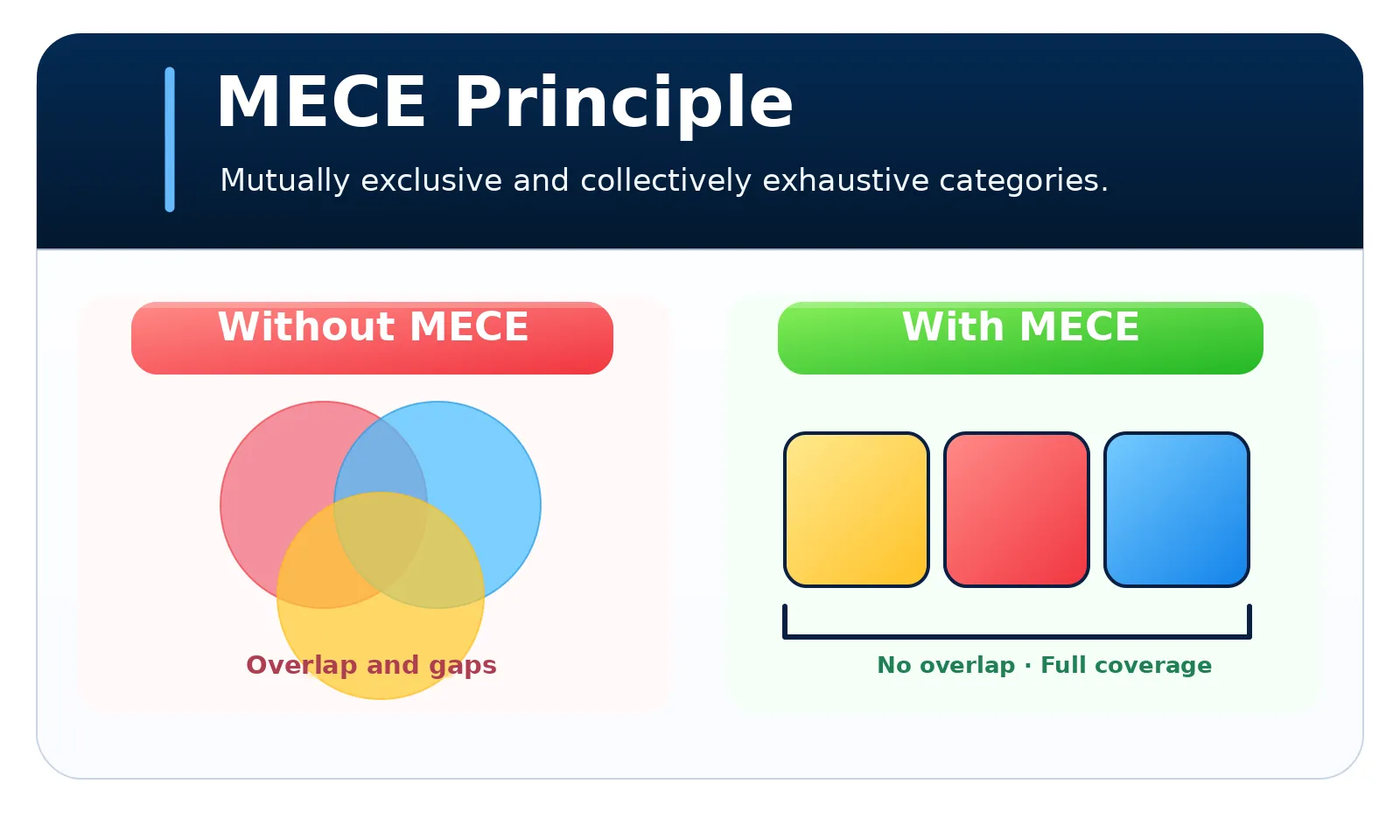
The board asks why revenue fell, and the answer arrives split into “new customers”, “large customers” and “e-commerce customers”. A new, large e-commerce customer sits in all three groups. The percentages add up to 140%, and nobody can say where the drop came from.
The problem here is one of structure. When parts overlap, the same element gets counted more than once. When there are gaps, part of the problem vanishes from the analysis. The MECE principle is a simple discipline for avoiding both.
What the MECE principle is
The acronym stands for Mutually Exclusive, Collectively Exhaustive. A breakdown is MECE when it meets two conditions at once:
| Condition | Test question | Typical failure |
|---|---|---|
| Mutually exclusive | Does any element fit two groups? | “Daily users” and “power users” |
| Collectively exhaustive | Is any element left without a group? | Revenue bands with no place for those who didn’t report |
The idea is associated with Barbara Minto, who developed it at McKinsey in the late 1960s and used it as the basis of her Pyramid Principle (Wikipedia).
Universe, unit and criterion
No list is MECE in the abstract. Before dividing, three things need to be written down:
- Universe: the complete set. For example, all accounts created in September.
- Unit of analysis: what is being classified. Account, user, transaction and ticket produce different breakdowns.
- Criterion: the rule that separates the groups. For example, the most advanced stage reached.
Mixing criteria at the same level is the most common source of overlap. “New”, “large” and “e-commerce” use three different criteria: relationship length, size and channel. Each of them can produce a MECE breakdown, as long as it’s used alone at each level.
When to use it and when to avoid it
When to use it
- To locate a problem in a funnel, a revenue line or a cost
- To segment customers, requests or tickets
- To build issue trees and structure reports
- To define classification categories, including with LLMs
When to avoid it
- In brainstorms, when the goal is to generate ideas without a filter
- When overlap is desirable, as with security layers
- When reality is continuous and the cut would be arbitrary
- As an end in itself, with no question to answer
How to apply it
- Define the universe and the unit. Write down what is in and what is out.
- Choose one criterion per level. If you need another criterion, open a level below.
- Write operational definitions. Each group needs a rule that a data query can execute.
- Handle boundaries and unknowns. Use limits without ties, such as 0 to 3, 4 to 12 and 13 or more, and create a place for missing data.
- Test. Run edge cases through the rule and check that the sum of the groups equals the total.
Example: where activation is falling
A B2B SaaS platform launched an AI assistant, and activation fell from 40% to 30%. Saying “users are confused” doesn’t help locate the problem. So the team defines:
- Universe: accounts created in a period, comparing the 1,000 before the launch with the 1,000 after it.
- Unit: account, not user.
- Criterion: most advanced stage reached within seven days.
Each account has a single most advanced stage, which guarantees exclusivity. The “no event data” row guarantees exhaustiveness.
| Most advanced stage in 7 days | Before | After |
|---|---|---|
| Signed up, didn’t connect data | 200 | 180 |
| Connected data, didn’t generate a result | 220 | 340 |
| Generated a result, didn’t save it | 150 | 150 |
| Saved or shared (activated) | 400 | 300 |
| No event data | 30 | 30 |
| Total | 1,000 | 1,000 |
Because it’s MECE, the table balances: the 100 fewer accounts in “activated” and the 20 fewer in “signed up” reappear as 120 more in “connected data, didn’t generate”. The problem now has an address, and that’s where the fishbone diagram should concentrate its hypotheses.
Testing the boundaries
Rules only prove themselves on hard cases:
| Case | Where it falls | Why |
|---|---|---|
| Generated on day 6, saved on day 8 | Generated, didn’t save | The window closes at seven days |
| Account with two users, one saved | Activated | The unit is the account |
| Internal test account | Outside the universe | Excluded by definition |
| Saved, but the generation event is missing | Activated | The most advanced stage counts |
The last case also points to a possible instrumentation defect, which deserves a separate check.
How to use an LLM
An LLM helps propose criteria, write definitions and invent edge cases you hadn’t considered. It can also review a list and point out overlaps. The final check comes from the data: a taxonomy can look perfect on paper and fail on the first query.
The principle matters even more when the LLM itself classifies text. If the categories “billing” and “cancellation” overlap, a message like “I want to cancel because you charged me twice” has no right answer, and the model will pick one with no stable criterion. Categories work as a contract, so they need a definition, a tie-breaking rule and a class for whatever doesn’t fit.
I want to break down [universe/problem] for [purpose].Unit of analysis: [customer, transaction, request, cost, etc.].Main segmentation criterion: [criterion].Known data and exceptions: [describe].
Create a MECE classification with operational definitions, boundaryrules and handling for unknown or unclassifiable cases.Use a single criterion per level.
Test the structure with at least five examples, including edge cases.Point out possible overlaps or gaps and say which examples the ruledoesn't resolve.
Expected output: a taxonomy with inclusion and exclusion criteria and the test results.
Before trusting the answer:
- Run it on the data. Apply the rules to a sample and check that the sum of the groups matches the total.
- Look at the size of the residual category. A very large “other” class means the criterion isn’t working.
- Bring your own hard cases. Examples invented by the model tend to be cleaner than real ones.
- Sanitize the context. Use samples without personal data.
Combine it with other frameworks
- Fishbone diagram: after locating the problem, maps candidate causes at that point.
- 5 Whys: goes deeper into the most promising cause.
- Decision matrix: criteria without overlap avoid double counting in the weights.