A company rolled out an AI tool to everyone three months ago, and only 22% of people use it each week. Leadership proposes making it mandatory and publishing a ranking by team. It’s the intuitive response: if the change isn’t moving, push harder.
Force field analysis asks a different question: what’s holding this change back? The answer often leads to a different decision, sometimes a cheaper one, than adding pressure.
What force field analysis is
Force Field Analysis is associated with the psychologist Kurt Lewin. He borrowed the idea of a force field from physics and used it to understand human behavior (Coghlan, 2014). The list version widely used today is a variant that became popular in the 1990s, long after his death (Burnes & Cooke, 2013).
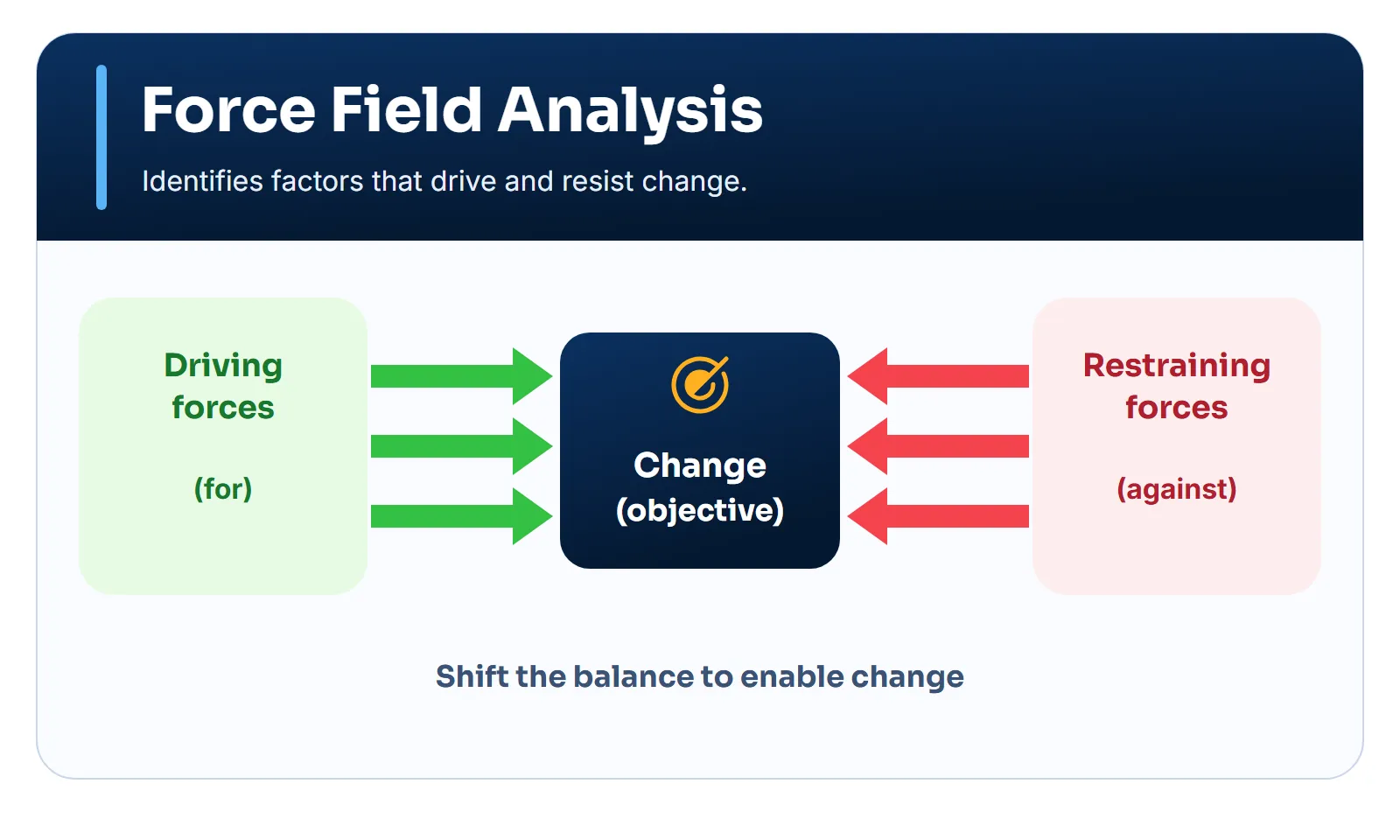
The central idea is quasi-stationary equilibrium. A situation looks stable, but that stability results from forces in opposition. Adoption at 22% isn’t a resting point: there are people pushing it up and factors pushing it down, and they cancel out at that level.
Changing, then, means altering that balance. There are three ways: strengthen the driving forces, reduce the restraining ones or do both (Institute for Manufacturing, Cambridge). So whoever seeks change isn’t trying to balance the forces: they want to unbalance the current state and stabilize a new one.
The three-step model, unfreeze, change and refreeze, is widely attributed to Lewin. It’s worth knowing that this authorship is disputed: Cummings, Bridgman & Brown (2016) argue he never developed that model, which took shape after his death.
Why pushing harder doesn’t always work
Increasing the force in favor is the obvious way out, because it only takes an order. It carries three risks:
- Pressure doesn’t change the cause. A ranking doesn’t make the tool more reliable or fix the integration. The barrier is still there.
- Pressure can trigger a reaction. If one force goes up, others tend to react to keep the equilibrium: resistance, token use or workarounds.
- The gain may not last. When the pressure eases, the system tends to return to its earlier level, because the barriers remain intact.
Writing on Lewin often stresses that reducing restraining forces works better than increasing driving ones. Treat that as sound practical guidance, not as a measured result. There are cases where pressure is necessary, such as a regulatory deadline or a system due to be shut down on a set date.
When to use it and when to avoid it
When to use it
- Adopting tools, such as AI, and rolling out processes
- System migrations and reorganizations
- Changes in culture or working model
- When an approved initiative isn't moving
When to avoid it
- Decisions between options: a decision matrix fits better
- Crises that require immediate action
- When the technical cause of a problem is still unknown
- As numerical proof that a change will work
How to apply it
- Define the change. Describe the current state, the desired state and the deadline, with a number whenever possible.
- List the forces on both sides. Look at people, processes, technology, incentives and rules. Include who feels each force.
- Seek evidence. Use surveys, interviews and usage metrics. Mark what’s still an assumption.
- Assess the intensity. Score from 1 to 5 in conversation with the team and record the reason for each score.
- Choose where to act. Start with the strong barriers within reach of whoever leads the change.
- Set the signals. Decide how you’ll know a force has changed, before acting.
Example: an AI tool nobody adopts
A company of 400 people wants to take weekly use of its AI tool from 22% to 60% in six months. The project team interviewed 30 people, ran an internal survey and analyzed usage data. The forces in favor:
| Force | Score | Evidence |
|---|---|---|
| Time savings | 4 | Pilot with 30 people |
| Executive sponsorship | 4 | Monthly committee |
| Team requests | 2 | Support tickets |
The forces against:
| Force | Score | Evidence |
|---|---|---|
| Fear of exposing data | 5 | Internal survey |
| Low trust in the answers | 4 | Interviews |
| Difficult integration | 4 | Support tickets |
| Lack of training | 3 | Internal survey |
Don’t add up the scores. Adding 10 against 16 looks objective, but it means nothing: the scores have no common unit, and a single barrier can block everything. They exist to focus the conversation.
The map also changes the debate about the ranking. People afraid of exposing data don’t lose that fear because they’ve become an item in a competition. Pressure can lead to logins without real use, or to personal accounts, which worsens the very risk the company worries about. So the team chooses to tackle the barriers first:
| Barrier | Action | Signal |
|---|---|---|
| Fear of exposing data | Publish what can go into the tool | Fewer questions to legal |
| Low trust | Validate use cases by area | More people return in week four |
| Difficult integration | Connect the two most used systems | More tasks completed |
| Lack of training | Train by role, with real tasks | Use grows after each class |
The force in favor is put to use too, in a different way. Instead of a ranking, executives show how they use the tool in their own work, and the pilot teams share how much time they saved.
Mind the metric: a login isn’t adoption. Good signals are people who come back after four weeks, tasks completed and time saved, measured on a sample.
How to use an LLM
An LLM helps organize interviews, suggest forces that went unnoticed and propose actions for each barrier. It doesn’t know your company and tends to return generic change-management forces. Provide your own evidence and ask it to prioritize structural barriers.
Analyze the proposed change: [description].Current situation: [current state].Desired state: [result and deadline].Stakeholders: [groups involved].Available evidence: [surveys, interviews, metrics].
Build a Force Field Analysis with driving and restraining factors. Foreach factor, state the qualitative intensity, evidence, stakeholders andpossible actions. Prioritize initiatives that reduce structural barriers,instead of just increasing the pressure for change. Suggest adoptionsignals and a communication strategy.
Expected output: a map of forces and a change management roadmap.
Before trusting the answer:
- Separate evidence from assumption. Each force must point to something that came from your data.
- Listen to those living the change. Show the map to the people affected and ask what’s missing.
- Be wary of exact scores. The intensity the model suggests is a guess.
- Sanitize the context. Don’t include people’s names, individual assessments or identifiable internal surveys.
Combine it with other frameworks
- 5 Whys: investigates why a barrier exists.
- Pre-mortem analysis: anticipates what would make the change fail.
- Decision matrix: compares actions when the budget doesn’t cover them all.
- Hypothesis testing: checks whether removing the barrier increased adoption.
References
- Burnes, B. (2004). Kurt Lewin and the Planned Approach to Change: A Re-appraisal. Journal of Management Studies, 41(6), 977–1002. DOI
- Burnes, B. & Cooke, B. (2013). Kurt Lewin’s Field Theory: A Review and Re-evaluation. International Journal of Management Reviews, 15(4), 408–425. DOI
- Coghlan, D. (2014). Force Field Analysis. In The SAGE Encyclopedia of Action Research. SAGE. Link
- Cummings, S., Bridgman, T. & Brown, K. G. (2016). Unfreezing change as three steps: Rethinking Kurt Lewin’s legacy for change management. Human Relations, 69(1), 33–60. DOI
- Institute for Manufacturing, University of Cambridge. Force field analysis. Link
- Lewin, K. (1947). Frontiers in Group Dynamics. Human Relations, 1(1), 5–41. DOI
- Lewin, K. (1951). Field Theory in Social Science. Harper & Row.