Monday, nine in the morning: a production alert, three requests marked urgent and the architecture review that has been on the list for six weeks. By the end of the day, the list has shrunk, and the review is still there.
This isn’t just a lack of discipline. In five experiments, Zhu, Yang & Hsee (2018) showed that people tend to choose tasks with objectively worse outcomes when those tasks merely appear urgent, such as a short deadline with no real consequence. The authors call this the mere urgency effect. The Eisenhower Matrix is a simple way to push back against that bias, because it forces you to assess importance separately.
What the Eisenhower Matrix is
The matrix classifies tasks along two independent axes, urgency and importance. Crossing them produces four quadrants, each with an action.
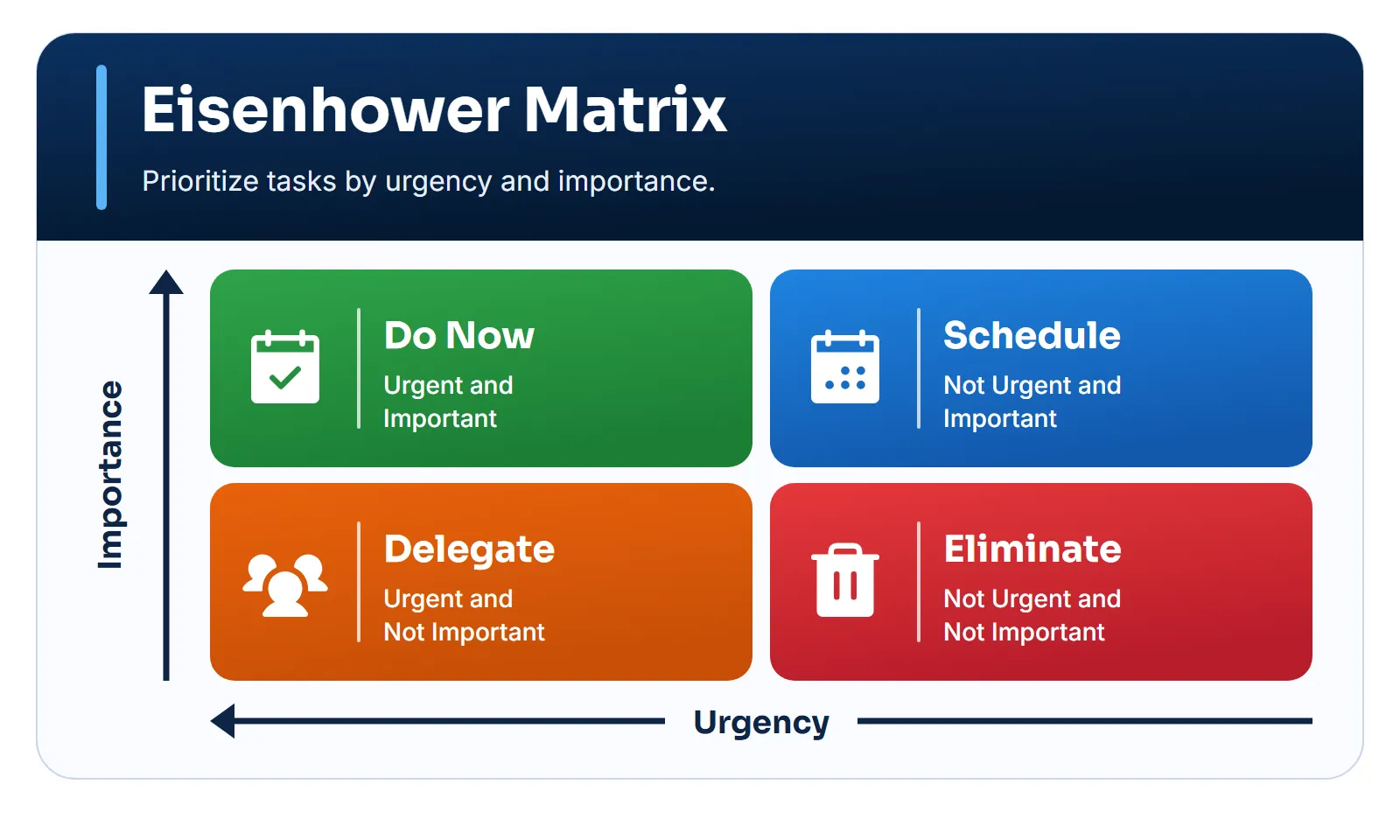
- Do now: urgent and important. Crises, incidents and real deadlines with consequences.
- Schedule: important and not urgent. Architecture, prevention, developing people. It needs a date on the calendar.
- Delegate: urgent and less important. It requires a response, but not necessarily yours, when someone else can take it on.
- Eliminate: neither urgent nor important. It can be cut, automated or critically postponed.
How to tell the two axes apart
Classification depends on two questions, asked separately:
- Important: does this affect a goal for the period or a responsibility only I can fulfill?
- Urgent: what actually happens if it waits a week?
The second question knocks down a lot of false urgency. Much of what arrives as urgent is someone else’s priority, or a deadline nobody has tested.
Where it came from
The name comes from a speech Dwight Eisenhower gave in Evanston on August 19, 1954. There, he quotes “a former college president”, without naming him: “I have two kinds of problems, the urgent and the important. The urgent are not important, and the important are never urgent” (Eisenhower, 1954).
The speech doesn’t describe any matrix, and the line isn’t even his. The four-quadrant grid became popular through Stephen Covey, in The 7 Habits of Highly Effective People (1989), and Eisenhower’s name stuck to it. The line itself is also an exaggeration: a production incident is urgent and important at the same time.
When to use it and when to avoid it
When to use it
- To organize an overloaded week
- In operational backlogs and ticket queues
- On a leader's calendar, to protect strategic work
- To decide what to decline or hand off
When to avoid it
- To compare alternatives: use a decision matrix
- To assess investments: use cost-benefit analysis
- To sequence tasks with dependencies: use the critical path
- To prioritize other people's work without hearing them
How to apply it
- List everything. Put requests, tasks and commitments in one place.
- Write down the period’s objectives. Without them, importance becomes opinion.
- Classify with the two questions. Assess importance first, so deadline pressure doesn’t contaminate the answer.
- Define the action. Do it, schedule it with a date, hand it off with context or cut it.
- Review every week. Tasks change quadrants, and what was scheduled can become urgent.
Example: a tech lead’s week
With the quarter’s goal set as platform stability and shipping the next version, a tech lead classifies the week:
| Task | Quadrant | Action |
|---|---|---|
| Production outage | Do now | Run the incident |
| Security fix with an audit deadline | Do now | Prioritize with the team |
| Next version’s architecture | Schedule | Block two fixed slots |
| Team mentoring | Schedule | Keep biweekly sessions |
| Repetitive report requested for today | Delegate | Hand off and automate |
| Recurring meeting with no agenda | Eliminate | Cancel and update in writing |
Two points from this table apply to any team.
The report seems urgent because someone asked for it today, but it doesn’t move any of the quarter’s goals. The best response is to take the task out of the queue for good, through automation.
The architecture has no deadline today, and that’s where the risk lies. If it’s always left for later, it comes back as an incident. A permanently full “do now” quadrant usually means the “schedule” work isn’t happening.
Delegating responsibly
Delegating is different from getting rid of something. For it to work, the person receiving the task needs the authority to decide, the competence to execute and the context to know what a good result looks like. If any of those is missing, the task comes back worse, and later.
How to use an LLM
An LLM helps turn a messy list into a table and challenge apparent urgency. It doesn’t know your goals, your real deadlines or company politics, so it can only apply the criteria you provide. Without that data, the classification is a well-formatted guess.
You are my prioritization facilitator. Classify the following activitiesin the Eisenhower Matrix: [list of activities].
Goals for the period: [goals].Deadlines and consequences of delay: [describe].Responsibilities only I can carry out: [describe].Available capacity: [hours and people].
For each task, explain the urgency and importance assessments separately,assign a quadrant and suggest doing, scheduling, delegating or eliminating.Challenge urgencies that seem to have no real consequence.
Propose an execution plan for [period] and point out the tasks whoseclassification depends on missing data.
Expected output: a priority table and a calendar that fits the stated capacity.
Before trusting the answer:
- Check the assumptions. See whether importance was justified by the goals you gave.
- Test the deadlines. For each item marked urgent, ask the requester what happens if it’s late.
- Add up the hours. Verify that the plan fits your real capacity.
- Sanitize the context. Don’t include people’s data, performance reviews or confidential company matters.
Combine it with other frameworks
- Decision matrix: the Eisenhower Matrix prioritizes activities by urgency and importance, while the weighted matrix compares alternatives across several criteria.
- Critical path method: shows which tasks hold up the deadline, something the Eisenhower Matrix can’t see.
- OODA loop: organizes the response when the “do now” quadrant is an incident in progress.
References
- Eisenhower, D. D. (1954). Address at the Second Assembly of the World Council of Churches, Evanston, Illinois. The American Presidency Project. Link
- Zhu, M., Yang, Y. & Hsee, C. K. (2018). The Mere Urgency Effect. Journal of Consumer Research, 45(3), 673–690. DOI
- Covey, S. R. (1989). The 7 Habits of Highly Effective People.